Rehearse your German job interview with questions based on your job ad.
Paste the job ad and a few notes about yourself. Answer the likely questions out loud and get feedback, then do a mock interview with follow-up questions.
Free to start. No card needed. Works for interviews in English too.

Scan to get the app


Free to start. No card needed. Works for interviews in English too.
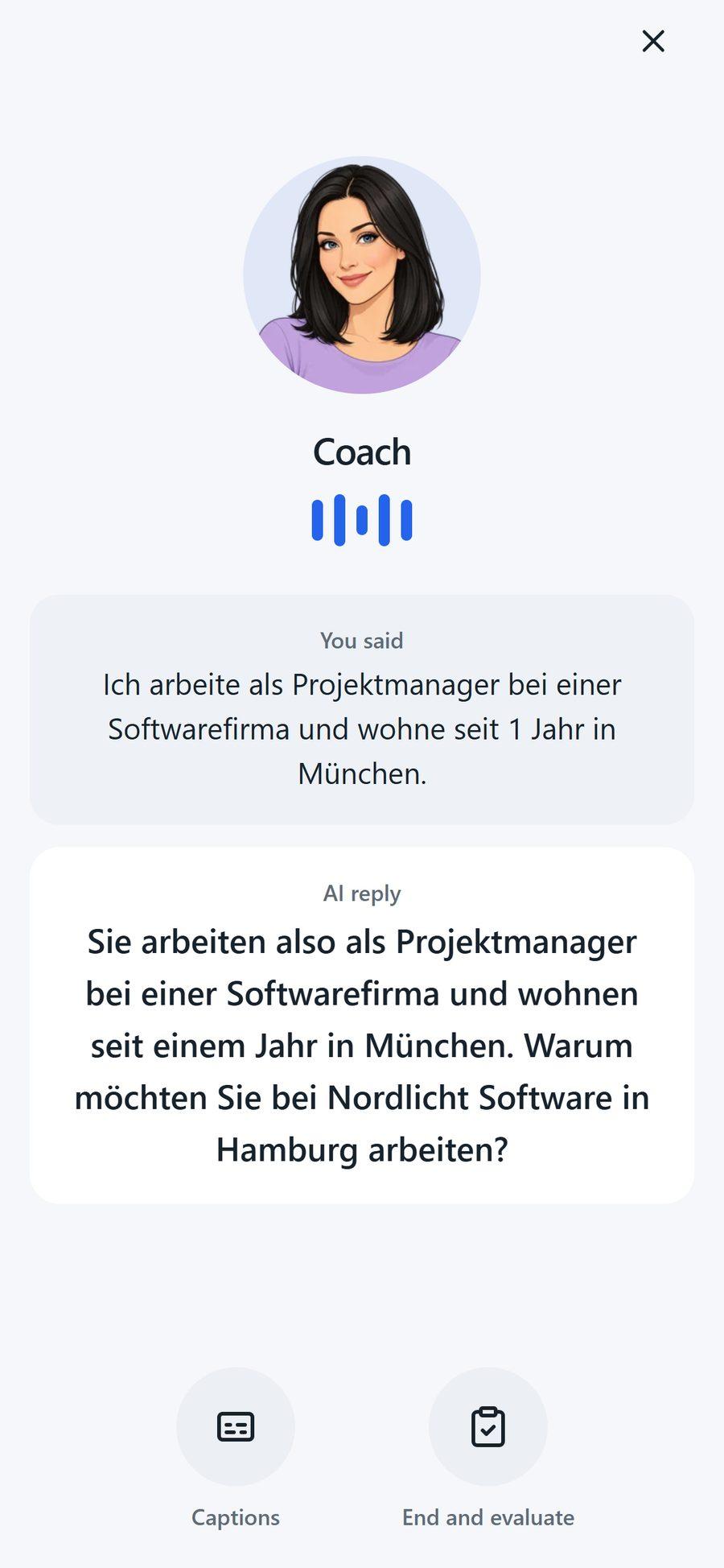

Warum möchten Sie bei Nordlicht Software in Hamburg arbeiten?
You said
Ich möchte bei Nordlicht arbeiten, weil ich viel Erfahrung mit Kundenprojekte habe.
Missing from your answer
Working with development teams, project planning, the Scrum Master certification.
"mit" takes the dative: mit Kundenprojekten
An example
What one job ad turns into
In this example, Nordlicht Software in Hamburg is hiring a software project manager to plan client projects, lead six developers, report to management and work with Scrum. The applicant's notes: five years as a project manager in Shanghai, a Scrum Master certificate, one year in Germany.
The app wrote these 15 questions in under a minute, each with a model answer based on the notes. Use the model answer as a starting point. The answer that counts is the one you can say out loud.
Model answer to question 3
Zuerst kläre ich mit dem Kunden die Ziele, den Umfang, die Prioritäten und mögliche Einschränkungen. Danach stimme ich mit dem Team Meilensteine, Verantwortlichkeiten und einen realistischen Zeitplan ab. Risiken und offene Fragen dokumentiere ich früh, damit wir sie regelmäßig überprüfen können.
The opening
Können Sie sich kurz vorstellen und Ihren beruflichen Hintergrund beschreiben?
Can you introduce yourself briefly and describe your professional background?
Warum möchten Sie bei Nordlicht Software in Hamburg arbeiten?
Why do you want to work at Nordlicht Software in Hamburg?
From the tasks in the job ad
Wie planen Sie ein neues Kundenprojekt?
How do you plan a new client project?
Wie gehen Sie vor, wenn die Anforderungen eines Kunden noch unklar sind?
What do you do when a client's requirements are still unclear?
Wie koordinieren Sie ein Team aus sechs Entwicklern?
How do you coordinate a team of six developers?
Wie setzen Sie Scrum in einem Softwareprojekt ein?
How do you use Scrum in a software project?
Was tun Sie, wenn ein Sprint nicht nach Plan läuft?
What do you do when a sprint does not go to plan?
Wie gehen Sie mit einem Konflikt zwischen Kunde und Entwicklungsteam um?
How do you handle a conflict between the client and the development team?
Wie berichten Sie der Geschäftsleitung über den Projektfortschritt?
How do you report project progress to the management?
Wie erkennen und steuern Sie Risiken in einem Projekt?
How do you spot and manage risks in a project?
Wie reagieren Sie, wenn ein Kunde während des Projekts zusätzliche Funktionen verlangt?
How do you react when a client asks for extra features during the project?
Wie priorisieren Sie Aufgaben, wenn Zeit und Ressourcen begrenzt sind?
How do you prioritize tasks when time and resources are limited?
From your own background
Wie nutzen Sie Ihre fünfjährige Erfahrung in Shanghai in einem deutschen Projektumfeld?
How do you use your five years of experience in Shanghai in a German project environment?
Wie stellen Sie sicher, dass im Team klar und effektiv kommuniziert wird?
How do you make sure the team communicates clearly and effectively?
Was wäre Ihr wichtigster Beitrag in den ersten Monaten bei Nordlicht Software?
What would be your most important contribution in your first months at Nordlicht Software?
Answer out loud
How one answer gets better
You hear the question and answer out loud. The feedback shows which key points you missed and how to say it better, with a short note on why.
The question
Warum möchten Sie bei Nordlicht Software in Hamburg arbeiten?
Your answer
Ich möchte bei Nordlicht arbeiten, weil ich viel Erfahrung mit Kundenprojekte habe.
Say it like this
Ich möchte bei Nordlicht arbeiten, weil ich viel Erfahrung mit Kundenprojekten habe und sie gerne strukturiert begleiten und dabei eng mit Entwicklungsteams zusammenarbeiten möchte. Die Stelle passt zu meiner Erfahrung in der Projektplanung und zu meiner Scrum-Master-Zertifizierung. Außerdem möchte ich mich langfristig in Deutschland weiterentwickeln.
The note
The answer omits collaboration with development teams, project planning, the Scrum Master certification, and the goal of long-term development in Germany. In German, "mit" requires the dative: "mit Kundenprojekten".
One tap keeps the better version as your answer.
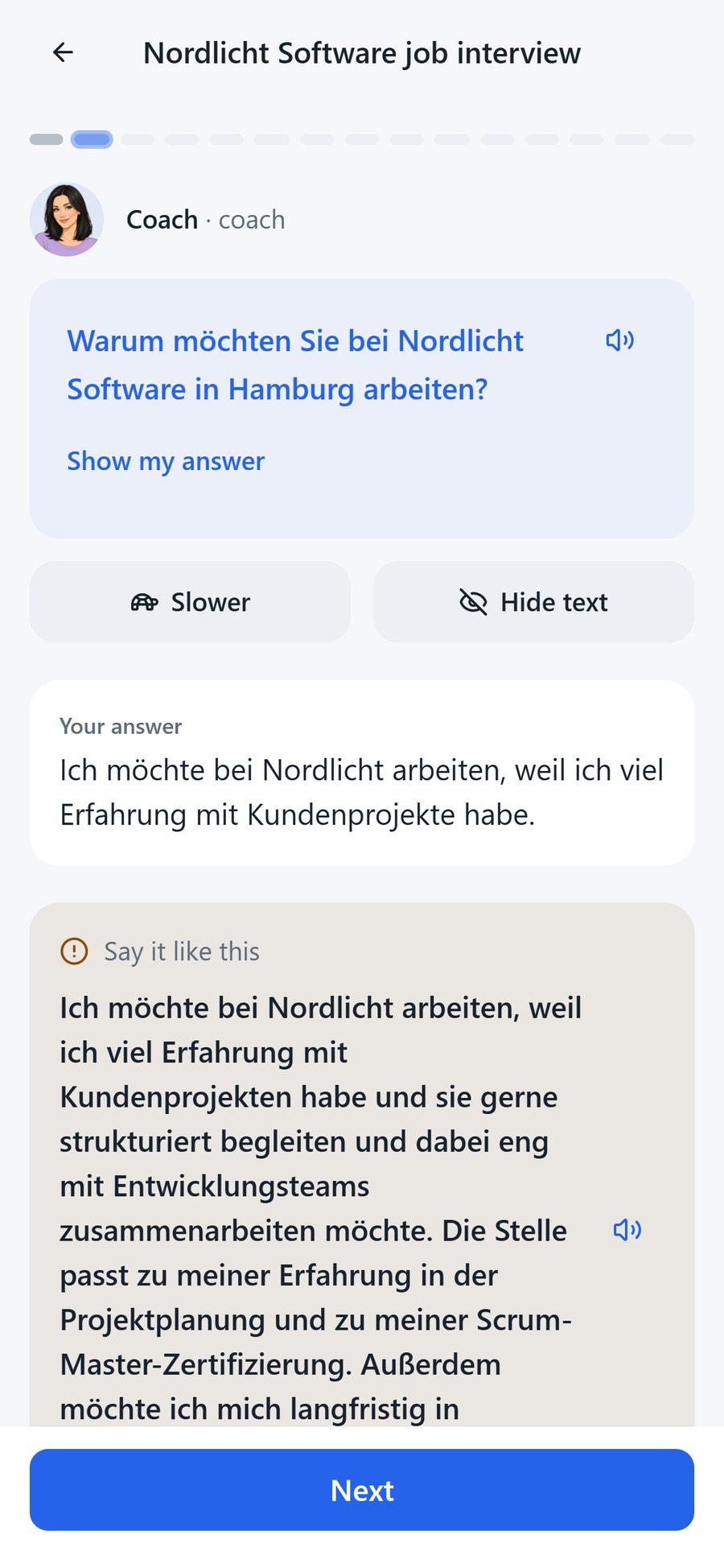
Slower. Hear the question again, more slowly.
Hide text. Listen only, as in the real interview.
Show my answer. Peek at your model answer when you're stuck.
Mock interview
Practice answering follow-up questions
Knowing your answers isn't the same as saying them under pressure. In the mock interview, the interviewer rephrases your questions, picks up on what you just said and asks more. By voice, or by text when you can't talk.
Afterwards you get the transcript and a correction for every sentence that went wrong.
Interviewer
Sie planen alle zwei Wochen einen Sprint und besprechen mit dem Kunden die Prioritäten. Warum möchten Sie als Software-Projektmanager bei Nordlicht Software arbeiten?
You
Weil Nordlicht Software Projekte für Kunden macht und ich habe viel Erfahrung mit Kunden. Ich möchte auch meine Deutsch im Beruf benutzen.
Interviewer
Sie möchten Ihre Deutschkenntnisse im Beruf einsetzen und Ihre Kundenerfahrung einbringen. Wie gehen Sie vor, wenn Sie ein neues Kundenprojekt planen?
Corrections after the conversation
You
… und ich habe viel Erfahrung mit Kunden.
Better
… und ich viel Erfahrung mit Kunden habe.
You
Ich möchte auch meine Deutsch im Beruf benutzen.
Better
Ich möchte auch mein Deutsch im Beruf einsetzen.
If the interview is this week
A plan for the last three days
About 30 minutes a day.
Three days before
Build the list and answer everything once
Paste the job ad and your notes. Read the questions, delete the ones that don't fit, and add the two you dread most. Then answer each one out loud once, without preparing.
Two days before
Fix the answers that didn't work
Go through the questions you haven't answered well yet. Compare your answer with the better version, keep the one you can really say, and repeat it until you don't need to read it. Shorten long answers: three sentences you can say freely beat six you recite.
The day before
Do the mock interview
Start a voice conversation and answer as if it were real, without stopping. Read the corrections, then try again if you have time. On the morning of the interview, go over just your introduction and your answer to "Why us?".
Worth having ready
Phrases for when you get stuck
The hardest moments are often not the big questions. They're the seconds when you didn't catch the question or can't find a word. Use these phrases to ask for a repeat or give yourself a moment to think. Add them to your training and you'll practice them too.
Get the appYou did not understand the question
Könnten Sie die Frage bitte wiederholen?
Could you repeat the question, please?
Meinen Sie damit …?
Do you mean …?
You need a moment
Das ist eine gute Frage. Lassen Sie mich kurz überlegen.
That is a good question. Let me think for a moment.
Ich würde das gern an einem Beispiel erklären.
I would like to explain that with an example.
A word is missing
Mir fällt das deutsche Wort gerade nicht ein. Ich meine …
The German word escapes me right now. I mean …
Anders gesagt: …
In other words: …
Your own questions at the end
Wie sieht die Einarbeitung in den ersten Wochen aus?
What does onboarding look like in the first weeks?
Wie geht es nach unserem Gespräch weiter?
What are the next steps after our conversation?
Questions about interview practice
I only have an invitation, no job ad. Does it still work?
Yes. Describe the role and the company in two or three sentences and add a few notes about your experience. The questions will be less specific than with a job ad, and you can add your own any time.
Can I practice an interview in English?
Yes. German and English are the two languages SceneLingo focuses on. Paste an English job ad and your practice is in English.
Will I be asked exactly these questions?
These are the likely questions for the role and your background, plus the ones almost every interview starts with. Once you can talk about your experience comfortably, surprise questions get easier too.
Why not ask a general AI assistant to interview me?
You can. Here you get one list of your questions and answers that you can edit and practice again and again, with strict corrections every time.
Does it check my pronunciation?
No. Feedback is based on the text of what you said: grammar, word choice and what was missing.
How much can I do for free?
The free plan has every feature and 2,000 credits: enough to set up your interview practice, answer the questions and do a short mock interview. For daily voice practice in the week before an interview, Standard costs €9.90 a month and you can cancel any time.
Say your first answer out loud today.
Paste your job ad and try your first question for free. It takes about five minutes.